










TotalBoat Thixo Fast Cure
- Two-part thixotropic epoxy adhesive
- Sandable and ready to accept high loads in only four hours
- Very high bond strength to a number of substrates
- Each cartridge comes with two static mixing tips
- Can be used above or below the waterline
- Comes in a 185 ml cartridge that fits most standard caulk guns
TotalBoat Thixo Fast Cure is a high-strength, two-part, fast-curing epoxy adhesive that is both stronger and cures over three times faster than standard Thixo. Ideal for bonding applications, it is ready for high loads in only four hours. Included mixing tips ensure the perfect resin-to-hardener ratio. The 185 ml cartridge fits most standard caulk guns.
Product Information
Cleaner / Surface Preparation
Acetone, denatured alcohol.
Cleanup
Denatured alcohol or acetone. Once cured, it must be removed mechanically.
Thinner / Reducer
Do not thin Thixo Fast Cure.
Mold Release Agents
Mold release paste wax, aerosol mold release agents.
Primer
No primers are necessary; etching with TotalBoat Aluminum Boat Etch Wash is highly recommended on bare aluminum substrates, and TotalBoat Rust Primer is recommended on ferrous steel applications.
Applications
Bonding, structural epoxy adhesive, filleting, small gap filling, gluing.
Acceptable Substrates
Fiberglass, wood, properly prepared metals, block, brick, concrete, glass, slate, tile, and stone.
Caulk Gun (Required for Use)
185 ml Thixo Fast Cure cartridges fit most standard caulk guns that allow for an offset nozzle. Guns that only have a small, centered hole for the nozzle will not work. An 8:1 mechanical advantage, or higher, is strongly recommended.
Safety & Personal Protective Equipment
Always use proper safety equipment, clothing, and PPE in accordance with the Safety Data Sheet for each product.
Exothermic Reaction: The cure of TotalBoat Thixo Fast Cure is an exothermic reaction and will generate heat. Though Thixo Fast Cure is generally applied in thin films or smaller applications, it is not uncommon for larger mixed masses to reach 200°F or higher during the cure cycle.
Surface Preparation
All surfaces need to be free of any potential contaminants. Surface contamination will reduce or compromise Thixo Fast Cure’s bond strength to any substrate. If any surfaces are to be sanded before applying Thixo Fast Cure, always remove all surface contaminants prior to sanding or abrading the surface. Contaminants can include dust, dirt, grease, moisture / water, oil, or wax.
Important: Only use clean cotton rags for surface preparation. Synthetic rags can leave a film of contamination if they come in contact with some solvents.
Fiberglass
- Fiberglass substrates may have wax or amine blush on the surface, depending on the resin system they’re made with and application methods.
- Any amine blush needs to be removed with fresh, warm water and a mild soap.
- Dry the surface completely. Any waxes need to be completely removed with a dewaxing product.
- After the surface has been cleaned of all potential surface contamination, grind the surface or abrade it with 80-grit or coarser sandpaper and remove all sanding residue.
- Then wipe with a clean cotton rag dampened with one of the specified surface preparation solvents.
- This will provide a rough surface for Thixo Fast Cure to achieve the best mechanical bond.
- Allow the surface to dry completely before applying Thixo Fast Cure.
Epoxy
- The cure of epoxy materials can create an amine blush on the surface of the cured material, even if the epoxy being used is considered “non-blushing.”
- Remove any potential amine blush by washing the surface with fresh, warm water and a mild soap. Dry the surface completely.
- Wipe the surface with a clean, dry cotton rag dampened with one of the specified surface preparation solvents.
- After the surface has been cleaned, grind or abrade it with 80-grit or coarser sandpaper and remove all sanding residue.
- Then wipe with a clean cotton rag dampened with one of the specified surface preparation solvents.
- This will provide a rough surface for Thixo Fast Cure to achieve the best mechanical bond.
- Allow the surface to dry completely before applying Thixo Fast Cure.
Wood
- Remove all surface contamination by wiping the surface with a rag dampened with one of the surface preparation solvents.
- Oily hardwoods and white oak should be wiped with acetone, if possible, during the surface preparation steps.
- Allow any solvents to evaporate completely.
- Abrade the area of the wood that is to be bonded with 80-grit or coarser sandpaper.
- Remove all sanding residue and wipe the surface clean using one of the specified solvent wipes.
- Allow the surface to dry completely before applying Thixo Fast Cure.
Metals
Steel / Iron
- Remove all surface contamination by wiping the surface with a rag dampened with one of the surface preparation solvents.
- Grind or sand the surface with 80-grit or coarser sandpaper, leaving it shiny and rough.
- Remove all sanding residue and wipe the surface again with a clean cotton rag dampened with the surface preparation solvent.
- Applying TotalBoat Rust Primer, as directed, is recommended, but not required. This will help to prevent further development of rust and optimize the bond.
- Allow the surface to dry completely before applying Thixo Fast Cure.
Stainless Steel
- Remove all surface contamination by wiping the surface with a clean cotton rag dampened with one of the surface preparation solvents.
- Allow the surface to dry completely.
- Grinding or sanding with 80-grit or coarser sandpaper the surface to be bonded can help maximize bond strength.
- If abraded, remove residue and wipe clean with solvent.
- Allow the surface to dry completely before applying Thixo Fast Cure.
Aluminum
- Remove all surface contamination by wiping with solvent; allow to dry.
- The aluminum surface should either be abraded with 80-grit sandpaper or a grinder immediately before bonding, or etched with TotalBoat Aluminum Boat Etch Wash, as directed.
- If abraded, remove residue and solvent-wipe; allow to dry before bonding.
- If etched, ensure the surface has dried completely before applying Thixo Fast Cure.
- Apply Thixo Fast Cure within 1 hour of surface preparation.
Lead
Safety Alert: Always take extreme care and use the required PPE when working with lead.
- Remove contamination by solvent wipe.
- Grind or sand with 80-grit or coarser sandpaper, leaving surface shiny and rough.
- Work quickly; lead oxidizes rapidly. Remove residue and solvent-wipe again.
- Allow solvent to evaporate and apply Thixo Fast Cure immediately. If delayed, repeat prep.
Other Metals
- Remove contamination with solvent wipe.
- Grind or sand with 80-grit or coarser sandpaper, leaving shiny and rough.
- Remove residue and solvent wipe again.
- Allow surface to dry completely.
- Within 1 hour, apply Thixo Fast Cure to prepared surface.
Stone
- Stone materials should always be dry and free of dirt, dust, or other residue.
- Do not attempt to bond stone that has recently been submerged in water for a long duration, if possible.
- Clean by wiping with appropriate surface prep solvents.
- Allow to dry completely before applying Thixo Fast Cure.
Masonry
- Masonry can be bonded, but ensure it has been left to dry for an extended period before application.
- Masonry can trap moisture, which can compromise bonding during pressure changes or freeze/thaw cycles.
- Clean away dust, debris, or loose material.
- Sand or abrade bonding area, remove residue, and solvent-wipe.
- Allow solvents to evaporate completely and apply Thixo Fast Cure.
Concrete
- Remove loose dust / debris and any contamination.
- Do not attempt to bond new concrete or moisture-emitting concrete.
- Sandblast or abrade to create mechanical bond profile.
- Etching, as directed, can further strengthen bonding.
- If etched, ensure the surface is completely dry before applying.
Glass
- Remove contamination by solvent wipe; denatured alcohol is preferred for glass surfaces.
- Allow surface to dry completely before applying Thixo Fast Cure.
Applications
Bonding
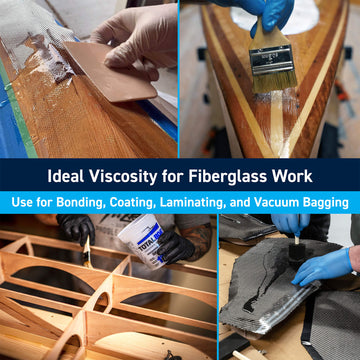
Thixo Fast Cure’s strength, thixotropic properties, and shorter working time make it a dynamic adhesive for many bonding applications for a wide variety of substrates. Thixo Fast Cure is safe to use below the waterline, or for structural applications, when the cured physical properties are adequate.
Filleting
When using Thixo Fast Cure to bond two items that are perpendicular, or at an angle, apply the epoxy between the two items. When they’re set in position, run an additional continuous bead roughly 1/8"–1/4" thick in the corner. Tool the bead with a rounded implement, like a tongue depressor, to make a smooth, uniform fillet. The fillet adds rigidity and stability by increasing the surface area of the bond.
Gap Filling
Thixo Fast Cure is not advised for most gap filling applications, but the largest gap that can be filled is up to 1/2" in thickness. Regular Thixo or Thixo Pro are the preferred Thixo products for gap filling.
Dispensing & Mixing
Application Conditions
Thixo Fast Cure should only be dispensed when ambient temperature, epoxy temperature, and substrate temperature are above 55°F, and relative humidity does not exceed 90% for the first 24 hours. Curing outside these conditions may slow cure or compromise properties. In cooler conditions, warm the cartridge to 70–80°F for ease of dispensing and better workability.
Caulk Gun
Use an appropriate caulk gun to dispense Thixo products. For ease of application, ensure that the caulk gun meets the minimum recommended mechanical advantage.
Mix Ratio
The mix ratio of Thixo Fast Cure is 2:1 resin to hardener. Thixo Fast Cure cartridges are constructed to automatically dispense at the rate of 2 parts resin for every 1 part hardener.
Static Mixing Tips
- Thixo Fast Cure can be dispensed with or without the static mixing tip threaded on the cartridge.
- The tips blend components as they exit, ensuring a fully mixed bead ready for use.
- Trim the tip opening to desired bead diameter.
- Install a new tip, then dispense 3–4" of bead as waste material. Do not use this material, as it may be resin- or hardener-rich.
- Do not attempt to clean or reuse tips. Leave the used tip on the cartridge and allow epoxy to cure inside; replace next use.
Dispensing Without a Static Mixing Tip
- Remove the threaded cap.
- Mark plug orientation if it will be reused later.
- Dispense and mix thoroughly by hand until color and texture are even.
Curing
Cure rates depend on temperature and mass. Gel time in a thin bead / film is roughly 30 minutes at 77°F. It can be sanded or used for medium- to high-load applications within 4 hours at 77°F. Full cure is roughly 2–5 days. Warmer conditions shorten cure times; cooler conditions extend them.
Clamping
Recommended clamp time is 24 hours. Avoid over-clamping, which can squeeze epoxy out of the joint and weaken it. Ensure an even, thin film remains between bonded parts.
Product Storage
- Store Thixo Fast Cure between 60–90°F, sealed tightly, in a dry place, before and after use.
- Do not store on the floor or near windows / doors that may expose cartridges to cooler conditions.
- Cool storage or exposure to dust / humidity increases crystallization risk.
- If reinstalling the original plug, avoid swapping resin / hardener sides; marking the plug helps prevent this.
- When using static tips, leave the used tip on to act as a seal. Replace with a new tip next use.
Crystallized Epoxy
- Crystallization may appear as grittiness, cloudiness, or thickened consistency.
- Do not use crystallized epoxy until resolved.
- Warm to 125–150°F to restore proper consistency.
- Place cartridge in a sealed plastic bag and warm in a bowl or basin of warm, not boiling, water, changing water as needed.
- Warming may take 30–90 minutes until cartridge contents reach at least 125°F and are fully clear.
- Proper storage is the best prevention.
Application Data
| Application / Epoxy Type | Adhesive, bonding, sealing, filling |
|---|---|
| Application Film Thickness | Thin film up to 1/2" |
| Application Temperature / RH | Minimum of 55°F, 0–90% relative humidity |
| Working Time | 20–45 minutes @ 77°F (thin film / bead) |
| Gel Time | 30 minutes, thin film @ 77°F; 10 minutes, 150 g mass @ 77°F (ASTM 2471) |
| Minimum Clamp Time | 4 hours @ 77°F |
| Minimum Cure for Light Use | 4 hours @ 77°F |
| Full Cure Time | 2–5 days |
| Resin Density | 9.6 lbs./gallon @ 77°F |
| Hardener Density | 8.6 lbs./gallon @ 77°F |
| Mix Ratio (by Weight) | 100A:46B, calculated |
| Mix Ratio (by Volume) | 2A:1B, calculated |
| Sag Resistance | 1/2" vertical surface |
| Mixed Viscosity | Thixotropic (ASTM 2196) |
| Shelf Life | At least 1 year under proper storage conditions |
Physical Data
| Cured Color / Finish | Off-White to Buff |
|---|---|
| Components | Two — Resin (Part A), Hardener (Part B) |
| Units | 185 ml cartridge |
| UV Stable | No |
| Tensile Strength | 8,500 psi (ASTM D638) |
| Tensile Modulus | 372,000 psi (ASTM D638) |
| Tensile Elongation | 7.4% (ASTM D638) |
| HDT (Post Cure) | 133°F (ASTM D648) |
| Compressive Strength | 9,600 psi (ASTM D695) |
| Flexural Strength | 13,200 psi (ASTM D792) |
| Flexural Modulus | 393,000 psi (ASTM D790) |
| Volumetric Yield / Coverage | Roughly 59' of bead @ 1/8", or 175 sq. in. spread @ 1/16" thickness, not accounting for waste, per 185 ml cartridge |
| Volumetric Shrinkage | 3.85% (ASTM D792/D1475) |
| Tensile Adhesion (Wood) | 1,380 psi (ASTM 4541) |
| Tensile Adhesion (Aluminum) | 1,890 psi (ASTM 4541) |
| Tensile Adhesion (G-10 Plate) | 2,030 psi (ASTM 4541) |
| Hardness | 82 Shore D (ASTM D2240) |
Comments
0 comments
Please sign in to leave a comment.