



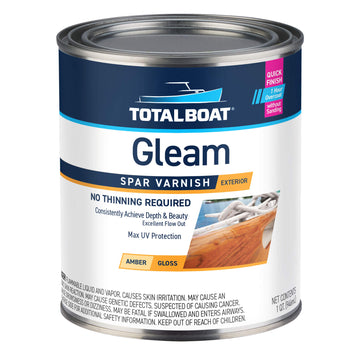

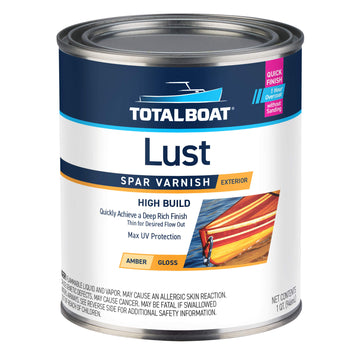

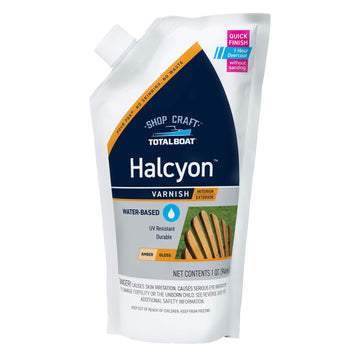



TotalBoat Gleam
- Easy-to-use spar varnish
- High-gloss or satin finish
- Quick-drying formula
- Fortified with UV inhibitors
TotalBoat Gleam is a high-quality, one-part marine spar varnish that provides a beautiful, long-lasting polyurethane finish with maximum UV protection. Gleam provides water resistance on brightwork on boats, strip canoes, kayaks and more, and is available in high gloss and satin. The forgiving formula makes great results easy to achieve.
Cleaner / Surface Preparation Solvents
- TotalBoat Dewaxer & Surface Prep
- TotalBoat Special Brushing Thinner 100
- TotalBoat Spray Thinner 101
- Denatured alcohol (bare substrates only)
- Acetone (bare substrates only, but specifically recommended for use on oily hardwoods or bare white oak substrates)
Cleanup Solvents
Thinner / Reducer Solvents
- TotalBoat Special Brushing Thinner 100 for brushing and rolling applications
- TotalBoat Spray Thinner 101 for spraying and cool weather brushing/rolling applications
Primer / Precoat / Sealer
TotalBoat Wood Sealer (optional for seal coats)
Paint Strainer
Fine paint strainers are ideal; medium paint strainers are usually sufficient for build coats.
Acceptable Substrates
Wood, properly prepared epoxy, previously varnished wood in good condition, or previously painted surfaces
Personal Safety
Always use proper Personal Protective Equipment when applying or handling this product. Refer to the TotalBoat Gleam Safety Data Sheets for more info.
Warning!
RAGS, STEEL WOOL, OR WASTE SOAKED WITH THIS PRODUCT MAY SPONTANEOUSLY CATCH FIRE IF DISCARDED IMPROPERLY. IMMEDIATELY AFTER USE, PLACE RAGS, STEEL WOOL, OR WASTE IN A SEALED, WATER-FILLED METAL CONTAINER.
Surface Preparation
Bare Wood
- Wood should be in good condition, dry, and free of any grease, oils, tar, dust, wax, or other potential contaminants, prior to sanding.
- The ideal wood moisture content to varnish is 6-8% but being less than 10% typically yields good results. Varnishing wood with a higher moisture content is not recommended.
- Sand the wood smooth, in the direction of the grain, with 220-grit sandpaper, until it is even and smooth.
- Vacuum away any sanding dust.
- If desired, a tack cloth can be used to help remove any residual dust, then follow with a clean, lint-free cotton rag wetted with one of the specified cleaner/surface preparation solvents.
- Allow the surface to dry completely before applying Gleam.
Previously Varnished Surfaces
- Previously varnished surfaces in poor condition should be stripped back to the bare substrates. Only apply Gleam to varnished substrates in good, sound condition that do not show signs of delamination, cracking, or peeling.
- Wash the surface with a mild soap and water, and rinse thoroughly.
- Once dry, wipe the surface with one of the specified cleaner/surface preparation solvents using a clean, lint-free cotton rag.
- Allow any solvents to evaporate.
- Sand the surface, in the direction of the grain, with 220-grit or 320-grit sandpaper, until it is smooth.
- Remove any sanding residue by wiping the surface clean with a clean, lint-free cotton rag wetted with one of the specified cleaner/surface preparation solvents.
- Allow the surface to dry completely before applying Gleam.
Teak
- Bare teak wood in good condition has a warm, golden tone. Teak that has been exposed to the elements and has sat for a while may take a gray appearance.
- If the teak wood has a gray appearance, it should be cleaned with TotalBoat Teak Cleaner to restore it to the original warm, golden color. Use Part A and Part B as specified on the instructions and allow ample time for the wood to dry after. Varnish or other coatings applied to damp wood may blister up or delaminate from the wood if it has not had sufficient time to dry.
- Once the teak has been cleaned and thoroughly dried, follow the surface preparation instructions for bare wood.
Epoxy Surfaces
- Epoxy substrates need to be fully cured for at least 5-7 days prior to any surface preparation or applying varnish.
- Once cured, the epoxy must be washed with a mild soap and warm water, then rinsed well to remove any possible amine blush, whether noticeable or not. This must be performed, even if the epoxy is considered non-blushing, or does not appear to have an amine blush on the surface.
- Dry the surface completely.
- Sand the surface with 220-grit or 320-grit sandpaper. A DA (dual action) sander can help to reduce a sense of grain, or sanding marks that show a sense of sanding direction.
- Remove any sanding residue by wiping the surface clean with a clean, lint-free cotton rag wetted with one of the specified cleaner/surface preparation solvents.
- Allow the surface to dry completely before applying Gleam.
Previously Painted Surfaces
- Only apply Gleam on previously painted surfaces that are in good condition, or that are compatible with a solvent-based varnish being applied.
- Remove any dust, dirt, grease, oils, water, wax, or other possible surface contamination prior to sanding the surface.
- Sand the surface with 220-grit or 320-grit sandpaper. A DA (dual action) sander can help to reduce a sense of grain, or sanding marks that show a sense of sanding direction.
- Remove any sanding residue by wiping the surface clean with a clean, lint-free cotton rag wetted with one of the specified cleaner/surface preparation solvents.
- Allow the surface to dry completely before applying Gleam.
Application
VERY IMPORTANT - READ BEFORE VARNISHING!
- Stir or shake Gleam very thoroughly before use. This is extremely important to promote the most consistent finish with Gleam Satin, as the flattening agent settles over time.
- The minimum overcoat time for Gleam is 1 hour @ 80°F, 3 hours @ 65°F, or 8 hours @ 50°F (3 mils wet film thickness).
- Applying Gleam thicker than 3 mils wet film thickness will extend dry times dramatically, and could trap solvents, making the varnish squishy and soft, even if the surface has become tack-free.
- Applying the varnish too thin may reduce the gloss level and require more coats to achieve a desired finish.
- A maximum of 3 coats can be applied per day.
- Sanding is not required between coats if Gleam is overcoated within 48 hours.
- Do not attempt to sand Gleam unless the most recent coat has dried for a minimum of 24 hours.
- If 2-3 coats have been applied in one day, allow 48 hours drying time prior to sanding.
- Lightly scuff-sand with 320-grit sandpaper, hazing the surface, and reducing any high points or bumps in the varnish. Do not sand heavily or remove more than is required. Sandpaper that is coarser is not necessary and will only add deeper scratches that may print through once all varnish layers have cured. Remove any sanding residue before reapplying.
- Do not use any solvent wipes within 48 hours of applying Gleam as it may affect the previous layers, even if it seems hard and cured. A clean, dry cotton rag, or compressed air (with an oil and water separator) is usually sufficient for removing sanding residue. TotalBoat Special Brushing Thinner 100 is the preferred solvent wipe for sanding residue cleanup.
- If a tack rag is used to remove sanding residue, it is imperative to then wipe the surface with a clean, lint-free cotton rag dampened with TotalBoat Special Brushing Thinner 100 prior to applying the next coat of varnish.
- A minimum of 4-6 coats of Gleam are recommended. The actual number of coats to fill the wood’s grain will vary with each application.
- More coats will produce greater distinctness of image, and greater UV resistance.
Gloss vs. Satin Application
- Gleam Gloss should be used for all seal coats and all build coats, regardless of the final finish.
- Gleam Satin should only be used for the final 1-2 coats of an application, never for a seal coat or build coats.
Application Conditions
- Best results are achieved when the substrate, air, and varnish temperatures are between 60-85°F.
- Do not attempt to apply Gleam when the air, substrate, or varnish are below 45°F, or above 105°F.
- If possible, avoid applying or curing the material in direct sunlight.
- Do not apply during times of high humidity, when rain, dew, or fog may affect the drying or finish of Gleam.
First Coat on Bare Wood (Seal Coat)
- Reduce the varnish 25%, using the appropriate TotalBoat thinner for the application method. This will allow the varnish to penetrate and seal the wood grain.
- Due to the extra solvent and penetration, the first coat may take longer to become tack-free.
- A second seal coat may be applied, if desired, depending on how much of the first coat was absorbed into the substrate.
- Hint: To avoid reducing on the first coat. TotalBoat Wood Sealer can also be used on new wood, before applying Gleam. Simply apply 2-3 coats of Wood Sealer to bare, properly prepared wood. Allow to dry for 24 hours, lightly scuff-sand, and apply Gleam, as directed below.
Application Methods
Brushing Instructions
- TotalBoat Special Brushing Thinner 100 promotes the best flow, self-leveling, and working time for Gleam, under most application conditions.
- Below 60°F, TotalBoat Spray Thinner 101 can also be used as a thinner for brushing applications, to help promote a quicker tack-free time, without compromising proper flow, or working time.
- Gleam is designed to be ready to use and does not require any added thinner (after the first/seal coat) for most brushing applications, however 5-10% of the appropriate TotalBoat thinner can be added, as desired.
- Do not over-thin Gleam, as it will extend dry times, and will reduce the overall gloss level of the finish.
- Only use high-quality solvent-safe paint brushes and roller covers with Gleam.
- For best results, use a high-quality natural bristle brush that is designed for varnishes, that is an appropriate width and shape for the application.
- Foam brushes can be used very successfully for seal coats and build, but the preferred method to achieve the best finish is to use a high-quality natural bristle brush.
- 1/8" foam or mohair roller covers can be used, but nap or other hair rollers may leave hair or fine particles behind.
- The roll and tip method (applying varnish across the grain with a roller, and immediately following with a brush, in the direction of the wood grain) is also a very successful application method.
Spraying Instructions
- For most spray applications, reduce Gleam 10-20% with TotalBoat Spray Thinner 101.
- Always use the minimum amount of spray thinner possible to achieve the highest gloss finish and promote the fastest dry times.
- Actual percentage of reduction will depend on the spray equipment being used, and environmental conditions.
- Airless Spray: The pressure should be roughly 170 bar/2500 psi, with a .33-.41 mm (11-16 thousandths) tip size.
- Pressure Pot: The pressure should be 3.44-4.47 bar/50-65 psi (gun pressure), and 8-10 psi (pot pressure), while the tip size should be .89-1.4 mm (35-50 thousandths).
- Siphon Cup: The pressure should be roughly 3.44-4.47 bar/50-65 psi (gun pressure), with a 1.5-1.8 mm (60-70 thousandths) tip size.
Yearly Maintenance
Gleam can be cleaned with an all-purpose boat soap, such as TotalBoat Boat Soap, and water. For superior results on exterior applications, apply 1-2 coats of Gleam annually to maintain the finish and UV protection.
Physical Data
| Color | Clear Amber |
|---|---|
| Components | One |
| Units | Pint, Quart, Gallon |
| Finishes Available (@ 60°) | Gloss (>90%), Satin (40-50%) |
| Solids by Volume | 40% (+/- 2%) |
| Solids by Weight | 45% (+/- 2%) |
| Flash Point | 40°F |
| VOC Content | <475 g/L |
| UV Stable | Yes |
| Food Safe/Food Contact Safe (Once Cured) | No |
Application Data
| Application Method | Brush, Roll, Spray |
|---|---|
| Application Film Thickness | 1-2 mils dry @ 3 mils wet |
| Coverage (sq ft/gal) | 360-400 @ 3 mils WFT |
| Number of Coats | 4-6 coats (minimum) |
| Application Temperature/RH | 45-105°F, 0-85% RH |
| Minimum Overcoat Time | 1 hour @ 80°F, 3 hours @ 65°F, or 8 hours @ 50°F |
| Maximum Overcoat Time Without Sanding | 48 Hours |
Comments
0 comments
Please sign in to leave a comment.