






TotalBoat Gelcoat
- Available with white or neutral base, with or without wax
- Premium ISO/NPG gelcoat product
- Can be tinted with compatible coloring agents
- MEKP catalyst included with gelcoat
TotalBoat Gelcoat is a premium grade gelcoat that is great for all application methods. It resists sagging while being extremely resilient. In fact, its ISO/NPG (Isophthalic/Neopentyl Glycol) resins are considerably more durable and resistant than standard, orthophthalic resin-based formulas. TotalBoat Gelcoat can be custom tinted prior to catalyzing. Adding color to neutral gelcoat produces bold or dark colors; adding color to white gelcoat creates lighter, pastel colors. Both white and neutral base are available with and without wax.
Cleaner / Surface Preparation
Acetone
Cleanup
Acetone. Once cured, it must be removed mechanically.
Catalyst
MEKP (methyl ethyl ketone peroxide), 9% active (included with purchase of TotalBoat Gelcoat)
Thinner / Reducer
Styrene, Sea Hawk Patch Aid 8185 and Dura Technologies Duratec®.
Note: Acetone will reduce the viscosity but is not
recommended as a thinner.
Colorants / Tints
TotalBoat Pigment Dispersions; any tints that are safe for use with polyester resin.
Wax Additive
Paraffin wax additive
Mold Release Agents
Mold release paste wax, PVA (polyvinyl alcohol)
Primer
Only for specific applications, see directions for application with TotalBoat TotalProtect Barrier Coat.
Safety and Personal Protective Equipment
Always use proper safety equipment, clothing, and PPE in accordance with the Safety Data Sheet for this product, and any surface preparation materials. Only use polyester resin-based products with adequate ventilation.
Exothermic Reaction!
The cure of TotalBoat Gelcoat is an exothermic reaction and will generate heat. It is not uncommon for a mass of catalyzed gelcoat left in a mixing cup or paint tray to reach 300–400°F during the cure cycle.
Selecting Gelcoat With Wax vs. Without Wax
Overview: Catalyzed gelcoat, like any other polyester resin, requires the absence of ambient air for a full cure. If the material is cured in the presence of air, it will still generate the exothermic reaction and cure to become a firm plastic material, but it will not reach full hardness and will have a tackiness on the surface. Gelcoat can come with or without a wax material.
Gelcoat With Wax
The wax material is a paraffin wax that rises to the surface during the reaction, forming a barrier between the gelcoat and the air, allowing it to fully cure. Gelcoat with wax is recommended for a final layer of gelcoat that is exposed to the ambient air and is commonly used for repairs where a single coat is applied. Gelcoat with wax is generally not used in molds.
Gelcoat Without Wax
Gelcoat without wax is commonly used with molds, and when multiple layers of gelcoat are being applied. Paraffin wax additive can be added to unwaxed gelcoat for a final coat (20 drops of paraffin wax per ounce of gelcoat). PVA, or polyvinyl alcohol, can be sprayed or applied over unwaxed gelcoat to deprive it of ambient air, for a full cure. PVA can also act as a release agent in a mold if it is applied before any gelcoat.
Selecting a Colored Base vs. Neutral Base
White, Black, Light Gray, and Moon Dust are helpful as a great starting point that will not need a lot of tinting to achieve the most common gelcoat colors. Neutral gelcoat should be used to create bold, dark, or deep colors that are not close in shade to one of the other colored bases. Neutral gelcoat does not cure to a clear material if no colors are added to it.
Surface Preparation
Acceptable Substrates:
- Polyester resin*
- TotalBoat Polyester Fairing Compound*
- Previously gelcoated surfaces*
- TotalBoat Polyester Structural Repair Putty*
- TotalBoat TotalProtect**
Unacceptable Substrates:
- Unknown composite substrates
- TotalBoat High Performance Epoxy
- TotalBoat Traditional 5:1 Epoxy System
- Any other cured or uncured epoxy substrates
- Epoxy fairing materials
- Metals
- Wood
- Plastics
- Glass
- Ceramics
- Masonry
- Concrete
* Gelcoat can be applied directly to any catalyzed, uncured polyester
resin-based products. Any cured polyester resin-based products must
be dewaxed and any surface contaminants removed, then sanded.
** It is extremely important to only use these specific products,
and prepare the surface, as specified, with no substitutions.
Removing Surface Contamination From a Substrate, General Surface Preparation
- Gelcoat is extremely sensitive to certain surface contaminants. Dust, dirt, grease, oils, wax, amine blush, or moisture can all be considered forms of surface contamination.
- Ensure that all surfaces are void of any surface contamination prior to sanding any substrates.
- Gelcoat requires a rough surface to form a good mechanical bond. Sand with 80-grit sandpaper to create a surface that can provide a strong bond. Remove all sanding residue, taking extreme caution not to introduce any new surface contamination.
- Wipe the surface with a clean, lint-free cotton rag dampened with acetone, then follow with a dry, clean, lint-free cotton rag. Do not use synthetic rags.
Preparation for Applying Gelcoat in a Mold
- Take extreme care to ensure that the mold is clean, and free of all surface contaminants or other materials. The gelcoat will take on the exact image and texture of the mold’s surface.
- Only use molds that are structurally sufficient for the intended application.
- It is extremely important that a release agent such as PVA or a wax mold release material is sufficiently and properly applied to the mold surface.
- When a wax mold release agent is to be used, it is strongly recommended to apply and polish out 4–5 coats to ensure the surface is as smooth as can be, and a sufficient film of release agent is present.
Gelcoat Repair Surface Preparation
- Completely clean, degrease and dewax the area that is to be repaired. Do not use any oily or slow-evaporating solvents in the surface preparation process — use acetone ONLY.
- When repairing damaged or otherwise previously cured gelcoat, the area must be ground out to provide a sense of “tooth” for new gelcoat to adhere to.
- Spider cracks and other chips that are being repaired should be coarsely sanded or ground out with a rotary tool or angle grinder to form a V-shaped profile.
- When grinding/sanding out any repair area, there should be a 2:1 (or greater) width-to-depth ratio of the repair area to ensure a proper bonding area, and to allow the gelcoat to flex, as needed, at the repair point.
- Only sand or grind as deep as required to perform the repair; do not abrade deeper than necessary.
- Use acetone and a clean, lint-free cotton rag as a surface preparation solvent wipe. Do not use other solvents and do not use synthetic rags.
Surface Preparation for Applications Over Epoxy, Epoxy Fairing Materials, Epoxy Primers
Not all epoxy products are compatible with TotalBoat Gelcoat products. TotalBoat TotalProtect is an acceptable substrate for TotalBoat Gelcoat ONLY when all steps are performed as described. Failure to execute any step with accuracy may lead to delamination or uncured gelcoat.
- Only when it has fully cured, but before it is sanded, wash any epoxy substrate or fairing compound with a mild soap and warm water.
- Sand the surface fair, or smooth, as desired, with 80-grit sandpaper.
- Remove all sanding residue and apply TotalBoat TotalProtect as directed on the label.
- Allow the TotalProtect to cure for 5–7 days, under normal curing conditions.
- Wash the fully cured TotalProtect with a mild soap and warm water.
- Allow the surface to dry and sand the surface smooth with 80-grit sandpaper.
- Wipe the surface clean with a clean, lint-free cotton rag dampened with acetone. Follow by wiping the surface with a clean, dry, lint-free cotton rag.
- Apply TotalBoat Gelcoat, as directed.
Adding Colorants and Catalyzing
Coloring / Tinting TotalBoat Gelcoat
- Always add any tints or colorants prior to catalyzing any gelcoat.
- Only use tints that are acceptable for use with polyester resin and gelcoat.
- Do not add more tints to the gelcoat than specified, as this may compromise the cure or physical properties of the cured gelcoat.
- TotalBoat Gelcoat with the WHITE BASE should only be tinted up to 1% by volume, with compatible tints.
- Neutral base TotalBoat Gelcoat can be tinted up to 10% (up to 12% for red, yellow, purple, orange and light green) by volume.
- Always perform and completely cure test samples until the desired color has been achieved.
- When performing these test samples, allow each one to fully cure, wet sand as needed, and buff to a finished appearance to observe the color.
- Make small changes as needed, noting how much colorant is being added, until the desired color has been achieved.
- Once the desired color is achieved, scale up the amount of colorant used to make the required amount of colored gelcoat.
Catalyzing Gelcoat With MEKP
TotalBoat Gelcoat requires MEKP catalyst (methyl ethyl ketone peroxide, not to be confused with MEK, or methyl ethyl ketone) to cure.
- The specified rates are referencing 9% active MEKP catalyst.
- The ideal percentage of catalyst is 2%, but this amount may vary from 1–2.5% (3% for more extreme conditions or circumstances) based on ambient temperature and the desired working time.
- Helpful Hint: For a starting point of catalyst rates, please see the Catalyst Rates charts below.
- It is strongly recommended to only catalyze the amount of gelcoat that can be applied in a 10–15-minute period.
- For small, quick repairs, the maximum 2.5% can be added, but working time may be short.
- For larger applications, when extended working time is crucial, it is strongly recommended to use the minimal percentage of catalyst.
- Once the catalyst has been added to the gelcoat, it cannot be undone.
- Cooling catalyzed material will help extend the working time, while warming the material will shorten the working time dramatically.
- Over-catalyzation can lead to extremely short working times and can also cause cracks and signs of excess shrinkage in the gelcoat, with a dull surface finish.
- Too little catalyst can leave the gelcoat in a gummy state for an extended period, leaving it susceptible to contaminants.
Application Methods
Brush and Roll Method
- Generally, TotalBoat Gelcoat products do not need thinning for brushing and rolling applications.
- Always use an appropriate solvent-safe roller cover and natural bristle brushes for any gelcoat applications.
- Work diligently as soon as the gelcoat is catalyzed, and have spare roller covers available, if needed.
Spray Applications
- For best results and ease of application, only use spray equipment that is designed for gelcoat application.
- Thin TotalBoat Gelcoat with styrene, only as needed (up to 15%; adding more can affect the color of the cured gelcoat).
- The percentage of styrene needed is dependent on ambient conditions and the spray equipment being used.
- A 2.2–3.0mm tip size is recommended for spraying gelcoat.
- When Sea Hawk Patch Aid 8185 or Dura Technologies Duratec® are being used, follow the specific directions on the product for mixing and application.
Applications
Molds and Applications With Fiber Reinforcement
- A mold release paste wax or PVA material that is compatible with polyester resins should be applied to the mold, as directed.
- When a mold release paste wax is used, it is recommended to apply and polish out at least 4–5 coats of wax.
- Commonly, gelcoat without wax is applied directly into a mold with the intention that more layers of gelcoat can be applied.
- Apply 4–5 layers of gelcoat at 5 mils WFT (wet film thickness), until the desired 18–25 mils are achieved.
- Reinforcement fabrics such as fiberglass can be saturated with polyester resins and applied directly to unwaxed gelcoat in a mold.
- Once all reinforcement has been applied, all gelcoat and polyester resin can be cured together by placing the mold in a vacuum, spraying PVA over the polyester resin, or using waxed polyester resin as the final step.
- This creates a chemical bond with all layers.
- After demolding, remove PVA or wax, wet sand, and buff to the desired finish.
New Gelcoat or Repair Applications
- Perform all surface preparation, as directed above.
- Commonly, gelcoat without wax is applied with the intention that more layers can be applied.
- For many applications, apply 4–5 layers at 5 mils WFT until 18–25 mils are achieved.
- To fully cure, spray PVA over the surface or use waxed gelcoat for the final layer.
- Plastic sheeting over smaller repairs can also prevent contact with air and allow curing.
- After cure, remove PVA/wax, then wet sand and buff until the desired finish is achieved.
Wet Sanding and Buffing to a High-Gloss Finish
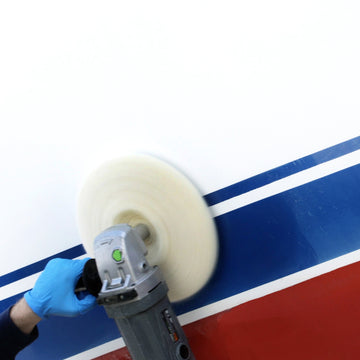
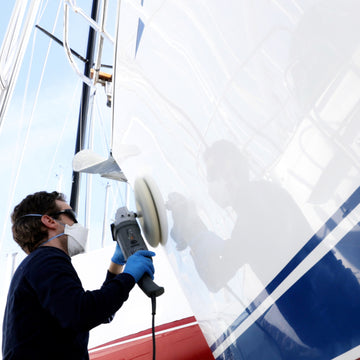
- TotalBoat Gelcoat can be wet sanded to work out any rough or high spots and buffed to a high-gloss finish.
- Before wet sanding, gelcoat should be fully cured and dewaxed.
- Wet sand only high points as needed; do not sand through gelcoat.
- Start with coarse paper (220-grit or 320-grit for rough areas) and work up to at least 1500-grit or finer.
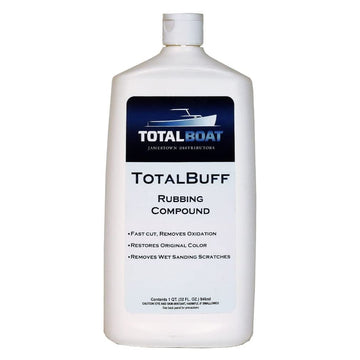
- Use a rubbing compound such as TotalBoat TotalBuff to bring out the high-gloss finish.
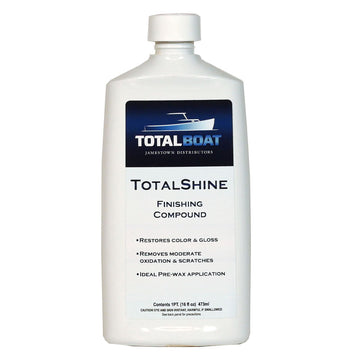
- Then use a finishing compound such as TotalBoat TotalShine to elevate the shine to a true mirror image.
- Finish by protecting the gelcoat with a high-quality wax product.
Product Storage
- Store this product in the original container.
- Store in a cool place (below 75°F), dry, well-ventilated area, away from ignition sources and incompatible materials.
- Keep container tightly closed when not being used.
Disposal of Empty Bottles: Do not empty remaining contents into drains. Dispose of contents and containers in accordance with local, regional, national, and international regulations.
Shelf Life
- TotalBoat Gelcoat has a limited shelf life and will, over time, gel in the container without the addition of catalyst.
- Shelf life is dependent on factors such as product formulation and storage conditions.
- As a rule, store properly. It may be helpful to warm this product above 60°F before use.
Application Data
| Application Method | Brush, Roll, Spray |
|---|---|
| Thinner / Reducer | Styrene — should not be required for most brushing/rolling applications; avoid adding more than 15% (may cause yellowing). Sea Hawk Patch Aid 8185 and Dura Technologies Duratec® may also be used per their directions. |
| Base Colors Available | White (with and without wax); Neutral (with and without wax) |
| Catalyzation Percentage | Varies from 1–3% based upon amount being catalyzed and environmental conditions. See Catalyst Rates charts below. |
| Application Temperature / RH | 50–95°F (70–80°F is ideal) |
| Viscosity | 5,000–8,000 cps at 77°F |
| Thixotropic Ratio | 7.5–9.5 |
| Application Thickness | Roughly 5 mils per coat, building up 18–25 mils |
| Working Time | 10–15 minutes (2% catalyst at 77°F, 1 ounce) |
| Gel Time | 8–12 minutes (2% catalyst at 77°F, 1 ounce) |
| Peak Exotherm During Cure | 335–400°F |
| Coverage (sq ft/gal) |
12.8 sq. ft. @ 1/8" ‡ 25.7 sq. ft. @ 1/16" ‡ 51.3 sq. ft. @ 1/32" ‡ ‡ Does not include wasted material. Add 10–15% extra for waste. |
Physical Data
| Vehicle Type | Unsaturated Polyester Resin |
|---|---|
| Components | 2 — Resin, MEKP catalyst |
| Specific Gravity | 1.1–1.4 |
| HDT | 185–205°F |
| Flash Point | 88°F |
| Storage | Store below 75°F and away from heat sources and sunlight. Store in a cool, dry area away from flames or heat sources. Keep container completely sealed. |
| Shelf Life | 6 months from date of manufacture |
| VOC Content | <400 g/L |
Catalyst Rates Charts (Starting Point)
Catalyzing Up to 6 oz. of Gelcoat
| Amount of Gelcoat to be Catalyzed | Drops of MEKP @ 50–65°F | Drops of MEKP @ 65–75°F | Drops of MEKP @ 75–80°F | Drops of MEKP @ 80–90°F | Drops of MEKP @ 90+°F |
|---|---|---|---|---|---|
| 1 oz | 18–20 | 16–18 | 14–16 (1.8% by weight) | 9–11 | 8–10 |
| 2 oz | 36–38 | 32–34 | 28–30 | 18–20 | 16–18 |
| 3 oz | 52–54 | 48–50 | 41–43 | 27–29 | 24–26 |
| 4 oz | 68–70 | 64–66 | 55–57 | 36–38 | 32–34 |
| 5 oz | 84–86 | 80–82 | 68–70 | 45–47 | 40–42 |
| 6 oz | 100–102 | 96–98 | 80–82 | 56–58 | 48–50 |
Catalyzing 8 oz. or More Gelcoat
| Amount of Gelcoat | 50–65°F (% by weight) | 65–75°F (% by weight) | 75–80°F (% by weight) | 80–90°F (% by weight) | 90+°F (% by weight) |
|---|---|---|---|---|---|
| 8 fl. oz. | .2 fl. oz. (2.5%) | .17 fl. oz. (2.1%) | .14 fl. oz. (1.8%) | .12 fl. oz. (1.5%) | .1 fl. oz. (1.2%) |
| 16 fl. oz. | .4 fl. oz. (2.5%) | .32 fl. oz. (2%) | .28 fl. oz. (1.8%) | .24 fl. oz. (1.5%) | .19 fl. oz. (1.2%) |
| 32 fl. oz. | .7 fl. oz. (2.2%) | .6 fl. oz. (1.9%) | .5 fl. oz. (1.6%) | .42 fl. oz. (1.3%) | .32 fl. oz. (1%) |
| 64 fl. oz. | 1.4 fl. oz. (2.2%) | 1.2 fl. oz. (1.9%) | 1 fl. oz. (1.6%) | .83 fl. oz. (1.3%) | .64 fl. oz. (1%) |
| 128 fl. oz. | 2.8 fl. oz. (2.2%) | 2.4 fl. oz. (1.9%) | 2 fl. oz. (1.6%) | 1.5 fl. oz. (1.2%) | 1.3 fl. oz. (1%) |
*Chart does not ensure equal working time for all temps/volumes of gelcoat. This is only intended as a starting point. Actual working times for the posted catalyst rates will vary. Larger masses of gelcoat catalyzed at the same percentage of MEKP catalyst will have shorter working times.
Important! It is strongly recommended to only dispense and catalyze the amount of gelcoat that can be used within 10–15 minutes of catalyzation, regardless of ambient temperature.
TotalBoat Gelcoat comes with enough catalyst to catalyze the entire container at roughly 1.56% (enough catalyst for about 11–12 drops per ounce of gelcoat per quart or gallon unit). For cooler conditions under 77°F, or applications requiring a higher rate than 1.56%, extra MEKP catalyst can be purchased.
Comments
0 comments
Please sign in to leave a comment.