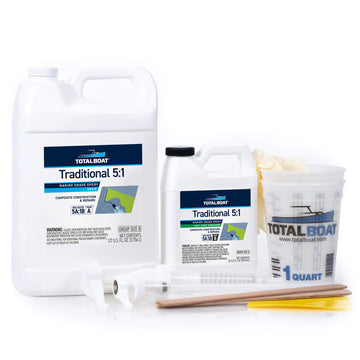









TotalBoat High Performance Epoxy System
- Easy 2:1 mix ratio with a choice of slow, medium, or fast hardeners
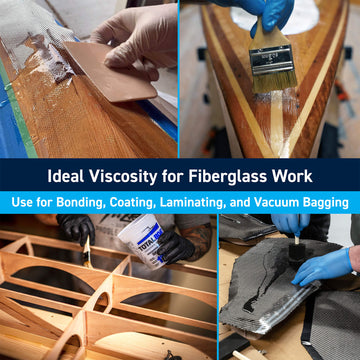
- Low-viscosity, non-blushing epoxy ideal for coating, laminating, hand layups, and vacuum bagging
- Can be thickened or filled for bonding, filleting, gluing, or fairing
- Compatible with wood, metals, fiberglass, carbon fiber, and more
- Usable above or below the waterline
- Can be tinted or pigmented
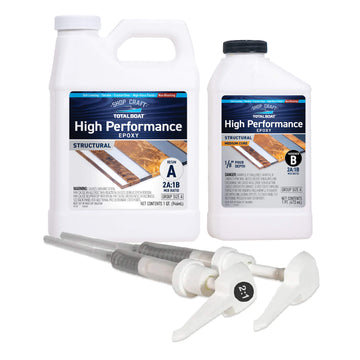
TotalBoat High Performance Epoxy is a low-viscosity, non-blushing epoxy system that cures clear and remains slightly flexible for superior performance. It’s ideal for clear coating, laminating, vacuum bagging, and wooden boat building. Mix the resin with TotalBoat High Performance Slow Hardener, TotalBoat High Performance Medium Hardener, or TotalBoat High Performance Fast Hardener in a simple 2:1 ratio by volume to control working and cure times.
Product Information
Cleaner / Surface Preparation
- Acetone
- Denatured alcohol
- TotalBoat Eco Solvent
Cleanup
Use denatured alcohol or acetone before cure. Once cured, epoxy must be removed mechanically.
Thinner / Reducer
Do not thin TotalBoat High Performance Epoxy.
Mold Release Agents
Mold release paste wax or aerosol mold release agents.
Primers
- Not required for most substrates.
- TotalBoat Aluminum Boat Etch Wash is recommended for bare aluminum.
- TotalBoat Rust Primer is recommended for ferrous steel.
Applications
Lamination, clear coating, hand layups, vacuum bagging, bonding, filleting, fairing, and small gap filling.
Acceptable Substrates
Fiberglass, epoxy, wood (not pressure-treated), properly prepared metals, masonry, concrete, glass, stone, and certain plastics.
Safety
Always wear proper PPE and follow all precautions on the Safety Data Sheet. Epoxy sensitization is serious; ensure adequate ventilation and skin protection.
Exothermic Reaction Warning: The curing process generates significant heat. Large mixed volumes can exceed 300°F. Mix small batches to prevent overheating.
Surface Preparation
All substrates must be clean, dry, and free of contamination before applying epoxy. Only use clean cotton rags; synthetic rags can leave residue.
Fiberglass
- Remove wax or amine blush using warm water and mild soap.
- Dry thoroughly, then abrade with 80-grit or coarser sandpaper.
- Clean with a solvent wipe and dry before applying epoxy.
Epoxy
- Remove any amine blush with soap and warm water.
- Dry completely, then sand and solvent wipe before applying new epoxy.
Wood
- Wipe with denatured alcohol or acetone to remove oils.
- Sand with 80-grit, remove residue, and wipe clean.
Metals
- Steel / Iron: Sand to bright metal, solvent wipe, and optionally prime with TotalBoat Rust Primer.
- Stainless Steel: Abrade with 80-grit, solvent wipe, and dry before bonding.
- Aluminum: Abrade or etch using TotalBoat Aluminum Boat Etch Wash and apply epoxy within 1 hour.
- Lead: Sand bright, solvent wipe, and apply epoxy immediately to avoid oxidation.
Stone, Masonry, Concrete, Glass & Plastics
Ensure all surfaces are dry, clean, and abraded as needed. For porous materials like concrete, avoid bonding when moisture is present. For plastics, test adhesion first; TotalBoat High Performance Epoxy bonds best to PVC, ABS, nylon, and polycarbonate.
Applications
Laminating & Reinforcement Fabrics
Use for wet layups with fiberglass, carbon fiber, Kevlar®, basalt, and other reinforcements. Apply only enough epoxy to saturate cloth, and avoid pooling. Excess epoxy adds weight and brittleness. For best results, vacuum bag laminates to remove air and excess resin.
Adding Fillers & Thickeners
- Silica: Increases sag resistance and adhesive strength.
- Milled glass fibers: Add strength for structural bonding.
- Microballoons: Improve sanding and bulk for fairing.
- Wood flour: Adds wood tone and structural integrity.
Bonding
Mix resin and hardener completely before adding fillers. Apply moderate clamping pressure; avoid over-clamping to maintain a film of adhesive.
Filleting
Use thickened epoxy (peanut butter consistency) to form a concave bead at joints. Smooth using a rounded tool for strength and clean appearance.
Fairing
For shallow fills (<1/8"), mix microballoons with silica for a smooth, easily sanded fairing compound.
Clear Coating
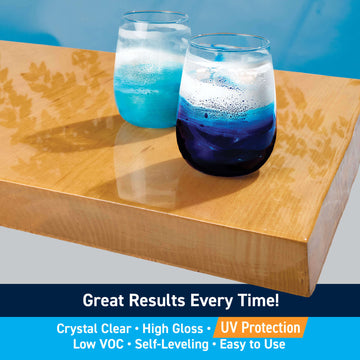
Use TotalBoat High Performance Slow Hardener or TotalBoat High Performance Medium Hardener for best clarity. Avoid thick pours that cause amber tinting.
Casting
Pour in thin layers to prevent exothermic cracking. Use proper mold release products. Allow each layer to cool to room temperature before recoating.
Tinting & Pigmenting
- Compatible with TotalBoat Pigment Dispersions, TotalBoat TotalTint Mixol Universal Pigments Kit, mica powders, and alcohol inks.
- Mix resin and hardener completely before adding colorants.
- Test small samples for compatibility and desired hue.
Dispensing & Mixing
- Mix ratio: 2 parts resin to 1 part hardener by volume.
- Use calibrated TotalBoat 2:1 Epoxy Pumps for accuracy (1 pump resin : 1 pump hardener).
- Do not adjust ratios or thin with solvents.
- Apply above 55°F with humidity under 90%.
- For clear applications, maintain <60% RH.
Curing & Clamping
- Cure time depends on hardener speed, temperature, and mass.
- Do not over-clamp; maintain a thin adhesive film.
- For porous wood, thicken epoxy to prevent absorption.
Storage & Crystallization
- Store sealed between 60–90°F, in a dry place.
- If crystallized, warm sealed container in 130–150°F water for 30–90 minutes.
- Proper storage prevents crystallization and extends shelf life to 1+ year.
Overcoating & Topcoats
- For recoating with epoxy: Wash, dry, and sand 80–220 grit before applying.
- For paints / varnishes: Wait 5–7 days, wash, sand with 180–220 grit, and apply.
- For gelcoat: Use approved primers, such as TotalBoat TotalProtect.
Application & Physical Data
| Property | Slow | Medium | Fast |
|---|---|---|---|
| Application Temperature | ≥55°F, ≤90% RH | ||
| Mix Ratio (by Volume) | 2A:1B | ||
| Working Time | 20–45 min | 10–30 min | 5–15 min |
| Gel Time (150g @ 77°F) | 40 min | 25 min | 10 min |
| Tack-Free | 5 hrs | 3 hrs | 2 hrs |
| Full Cure | 5–7 days | 3–5 days | 2–5 days |
| Tensile Strength | 7,300 psi | 8,000 psi | 7,700 psi |
| Compressive Strength | 8,900 psi | 9,900 psi | 9,500 psi |
| Hardness | 83 Shore D | 83 Shore D | 84 Shore D |
Troubleshooting Guide
| Symptom | Possible Issue | Solution |
|---|---|---|
| Epoxy did not cure | Improper mix ratio, poor mixing, contamination, or low temperature. | Allow 24 hrs more; if still soft, remove and reapply using correct ratio and clean surface. |
| Poor adhesion | Surface contamination or incompatible substrate. | Clean thoroughly and reapply following prep instructions. |
| White spots or haze | Moisture contamination during cure. | Ensure dry substrates and low humidity during cure. |
| Bubbles in cured epoxy | Entrapped air or porous substrate. | Mix slowly, avoid whipping air, and seal porous materials before coating. |
| Yellowing or cracking | Excess heat or UV exposure. | Use slow or medium hardeners; avoid direct sunlight during cure. |
| Topcoat or paint didn’t adhere | Surface not sanded or cured properly. | Follow full cure and sanding prep before coating; use compatible products. |
Comments
0 comments
Please sign in to leave a comment.