













TotalBoat Polyester Laminating Resin & Polyester Finishing Resin
- Extremely fast wet out and roll out
- Ortho, thixotropic
- Moderate trim time
- Early development of Barcol hardness
- Little or no patter transfer through gelcoat surfaces
TotalBoat Polyester Laminating Resin and TotalBoat Polyester Finishing Resin are Ortho GP, thixotropic polyester resins designed for fabrication of small to large FRP parts at an ambient temperature. This product is pre-promoted for curing at room temperature with the addition of methyl ethyl ketone peroxide (MEKP) catalyst. Material is designed to be used with both the spray-up and hand layup application techniques. Uses include yacht/boat construction and manufactured parts.
Surface Preparation Solvent
Acetone
Cleanup
Acetone. Once cured it must be removed mechanically.
Catalyst
MEKP (methyl ethyl ketone peroxide), 9% active (included with purchase of TotalBoat Polyester Resin)
Thinner / Reducer
Do not thin TotalBoat Polyester Resins.
Colorants / Tints
Colorants and tints are not commonly added, but can be added at a small percentage if they are compatible with polyester resin.
Wax Additive
Paraffin wax additive
Mold Release Agents
Mold release paste wax, PVA (polyvinyl alcohol)
Exothermic Reaction!
The cure of TotalBoat Polyester Finishing Resin or TotalBoat Polyester Laminating Resin is an exothermic reaction and will generate heat. It is not uncommon for a mass of catalyzed polyester resin left in a mixing cup to reach 200-300°F during the cure cycle.
Safety and Personal Protective Equipment
Always use proper safety equipment, clothing, and PPE in accordance with the Safety Data Sheet for each product, and only use polyester resin products with adequate ventilation.
Selecting Finishing vs. Laminating Polyester Resin
Overview: Catalyzed polyester resin requires the absence of ambient air for a full cure. If the material is cured in the presence of air, it will still generate the exothermic reaction and cure to become a firm plastic material, but it will not reach full hardness, and will have a tackiness on the surface. Polyester resin can come with or without a wax material.
Finishing Resin (With Wax)
The wax material in finishing resin is a paraffin wax that rises to the surface during the reaction, forming a barrier between the polyester resin and the air, and allowing it to cure fully. Polyester resin with wax is recommended for a final layer of polyester resin that is exposed to the ambient air. Finishing resin is commonly used for repairs where a single coat is being applied. Finishing resin is generally not used in molds.
Laminating Resin (Without Wax)
Laminating resin is commonly used with molds, and when multiple layers of gelcoat are being applied. Paraffin wax additive can be added to unwaxed polyester resin at the rate of 1 ounce of wax per 1 quart of polyester resin. PVA, or polyvinyl alcohol, can be sprayed or applied over unwaxed polyester resin to deprive it of ambient air, for a full cure. PVA can also act as a release agent in a mold if it is applied before any polyester resin saturated fabric.
Surface Preparation
Acceptable Substrates
Polyester resin*, TotalBoat Polyester Fairing Compound*, previously gelcoated surfaces*, TotalBoat Polyester Structural Repair Putty*, metals (that have been ground or heavily sanded to a bare, shiny finish, before they have a chance to oxidize at all – this will vary depending on the metal), wood substrates sanded to a rough surface
Unacceptable Substrates
Unknown composite substrates, cured or uncured epoxy substrates, epoxy fairing materials, plastics, glass, vinyl ester resins, ceramics, masonry, concrete
* TotalBoat Polyester Resin can be applied directly to any catalyzed, uncured polyester resin-based products. Any cured polyester resin-based products must be dewaxed and any surface contaminants removed, then sanded.
Applying Polyester Resin to a Surface
- Ensure that all surfaces are void of any surface contamination prior to sanding any substrates.
- Grease, oil, wax, dust, water, or any other substances can be considered a surface contaminant.
- Polyester resin requires a rough surface to form a good mechanical bond. Sand with 80-grit sandpaper (coarser than 80-grit is also acceptable) to create a rough surface that can provide a strong bond.
- Remove all sanding residue, taking extreme caution not to add any new surface contamination.
Applying Polyester Resin into a Mold with Gelcoat
- Apply PVA or a mold release wax material to the mold and apply gelcoat without wax to the mold, as directed on the gelcoat product.
- If a mold release paste wax is being applied, apply and polish out 4-5 coats before applying gelcoat.
- Apply reinforcement fabrics that have been saturated with polyester laminating resin to the gelcoat material. Commonly, the first layer of fabric (that is in contact with the gelcoat) is a chopped strand mat, which will help reduce any print-through of the subsequent layers after it has been demolded.
- There are 3 ways to through-cure the entire part in the mold:
- The final layer of reinforcement fabric should be saturated with finishing polyester resin that contains wax.
- Apply PVA over the final layer of reinforcement fabric once it is in the mold.
- Place the mold under a vacuum or use a vacuum pump and a vacuum bag kit over the final layer of polyester resin to remove the resin from the presence of ambient air.
Applying Polyester Resin into a Mold Without Gelcoat
- Apply PVA or a mold release wax material to the mold.
- If a mold release paste wax is being applied, apply and polish out 4-5 coats before applying any polyester resin.
- Apply reinforcement fabrics that have been saturated with polyester laminating resin to the prepared mold.
- Commonly, the first layer in the mold is a layer of chopped strand mat, to promote a smooth surface. Follow one of the 3 above methods to fully cure the part. Once cured, the part can be demolded.
Catalyzing Polyester Resins
Catalyzing with MEKP
- Polyester resin requires MEKP (methyl ethyl ketone peroxide, not to be confused with MEK, or methyl ethyl ketone) as a catalyst to cure.
- The ideal percentage of catalyst is 1%, but may vary from 1-2.2% by weight, based upon ambient temperature and the desired working time.
- For small, quick repairs, the maximum 2.2% can be added, but working time is short. For most applications, it is strongly recommended to use the minimal percentage of catalyst to ensure sufficient working time.
- Once the catalyst has been added to finishing or laminating polyester resins, it cannot be undone.
- Cooling the catalyzed resin will help extend the pot life and working time, while warming the material will shorten the working time dramatically.
- Over catalyzation can lead to poor or undesirable physical properties of the cured resin.
- Under catalyzation can lead to a much longer cure time than desired, or inadvertent post curing after demolding.
Application Methods
Brush and Roll Application
- Do not thin TotalBoat Polyester Resins.
- Only use natural bristle or solvent-safe bristle brushes, and solvent-safe roller covers with polyester resins. It is always recommended to have extra brushes and roller covers on hand in case the polyester resin does destroy them during use.
- Work diligently with catalyzed polyester resin to maximize working time.
Applications
Fiber Reinforcement
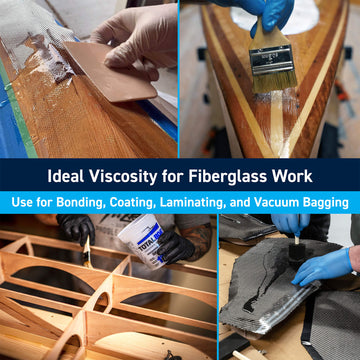
- TotalBoat Polyester Resin is a low-viscosity resin material that is designed for optimal flow and easy saturation of reinforcement fabrics. Polyester resin is compatible with fiberglass, Kevlar®, carbon, basalt, and hemp fibers*. Polyester resin is the glue to hold the fabric together and add to the rigidity.
- When wetting out fabrics, do not use extra resin, as the strength of a laminate comes from the fibers used.
- Use a laminating roller (also known as an epoxy roller) to help spread an even distribution of resin, and work any air bubbles out of the laminate.
- Do not leave pools or thick spots of resin, as it will shorten the working time in those isolated areas, and will cure to a more brittle, weaker material (also adding unnecessary weight and material to the final product).
- Use with Chopped Strand Mat (CSM): Also known as fiberglass mat, CSM is essentially short strands of fiberglass that are randomly oriented in different directions and stuck together using a binder material. Polyester resin contains styrene, which breaks down the binder when the resin comes in contact with the mat. This material helps to add bulk to a laminate quickly, being placed between layers of cloth or roving, and it also acts as a good first fabric layer when applied into a mold with gelcoat, as it will reduce print-through of subsequent fabric layers after it has been demolded.
* Though there are no incompatibilities, if Kevlar, carbon, or other specialty fabrics are being used with TotalBoat Polyester Resins, check to verify that the structural and physical properties of the polyester resin will meet the requirements of the application. Consult an engineer, if required.
Bonding and Gap Filling
- Polyester resin can be used for bonding and gap filling. Fillers and thickening agents will give the polyester resin different physical and working properties for a specific application. Depending on the application, mix the desired filler/thickening agent to the desired consistency, which can range from a gel viscosity to a peanut buttery consistency that does not sag. It is very common to blend a variety of fillers to achieve specific working or cured properties. Always add any desired fillers before catalyzing with MEKP. Depending on the application, laminating, or finishing resin may be desirable for filling and bonding.
- Colloidal silica can be used as an adhesive thickener that also adds sag resistance and body to liquid polyester resin and is commonly used for bonding or for preventing resin from being absorbed into a porous material, such as wood.
- Microballoons are very light in weight. They will make the cured material easier to sand, while at the same time adding body, increasing viscosity, and adding some sag resistance, but should not be used for bonding applications.
- Milled glass fibers are commonly used for structural bonding or structural filling applications.
Storage & Disposal
Storage of TotalBoat Polyester Resins
- Keep container tightly closed.
- Keep in a cool place under 70°F.
- Keep container in a well-ventilated place.
- Keep away from food, drink, and animal food.
- Keep away from sources of ignition.
Disposal of Empty Bottles
- Do not empty remaining contents into drains.
- Dispose of contents and containers in accordance with local, regional, national, and international regulations.
Shelf Life
- Polyester resin has a limited shelf life and will, over time, gel in the container without the addition of catalyst.
- The shelf life is dependent on a number of factors such as product formulation and storage conditions.
- As a general rule, however, the shelf life for uncatalyzed polyester resin should be up to 6 months when stored in dry, cool conditions below 70°F. Agitate and warm to above 60°F before use.
Application Data
| Application Method | Brush, Roll |
|---|---|
| Thinner | Do not thin TotalBoat Finishing or Laminating Polyester Resin |
| Catalyzation Percentage | 1% MEKP, 9% Active (7-8 drops of MEKP per ounce) ** The acceptable range of catalyst is 1-2.2% based on ambient conditions and required working time. DO NOT use more or less catalyst than this with TotalBoat Polyester Resin products. |
| Application Temperature / Relative Humidity | 50-95°F (70-85°F is ideal for a proper cure), 0-90% RH |
| Viscosity | 350-450 cps (@ 77°F) |
| Thixotropic Ratio | 1.7-2.2 |
| Working Time | Varies by mass and application thickness |
| Gel Time | Varies by mass and application thickness |
| Peak Exotherm During Reaction | 122-158°F Typical (This can vary more by catalyst rates, mass and application thickness) |
| Coverage (sq ft/gal) | 12.8 sq. ft. @ 1/8" *** 25.7 sq. ft. @ 1/16" *** 51.3 sq. ft. @ 1/32" *** *** Does not account for any material wasted during application; generally, 10-15% is wasted. |
Physical Data
| Vehicle Type | Unsaturated Polyester Resin |
|---|---|
| Color | Blue (before catalyzed/cured); Translucent amber (during/after cure) |
| Components | 2 - Resin, MEKP catalyst |
| Specific Gravity | 1.1 @ 77°F |
| Flash Point | 88°F |
| Tensile Strength | 8,958 psi § / 12,215 psi † |
| Flexural Strength | 17,205 psi § / 25,453 psi † |
| Flexural Modulus | 639,874 psi § / 966,920 psi † |
| Tensile Modulus | 682,532 psi § / 1,109,114 psi † |
| Barcol Hardness (934-1) | 41 § / 45 † |
| Water Absorption | .25% § |
| HDT | 155°F |
| Glass Content | 31.5% † |
| VOC | <400 g/L |
§ Cured resin @ 3mm thickness, post cured @ 230°F for 2 hours
† Laminated physical properties: 1.5 oz. chopped strand mat (2 plies) and 17 oz. roving cloth, glass content: 40%, post cured @ 104°F for 16 hours
Comments
0 comments
Please sign in to leave a comment.