








The intent here is not to make you an engineering expert, but to help you design laminates so most of the fibers are aligned with the loads that are associated with regular use of your boat or other watercraft.
To decide which laminant is best for your laminating project, there are four important areas of focus. The first three address the strength of the laminant, and the last addresses the weight of the laminant.
- Strand direction
- Weave style
- Fiber composition
- Weight, in ounces per square yard of reinforcement material
Strand Direction
A strand or fiber is the main load-bearing element in a laminant. The more fibers a laminant contains, the heavier and stronger it is. One way to categorize laminants is by the direction of their fibers, as follows:
- Unidirectional fabrics have fibers that are continuous and all oriented in the same direction. The fibers are usually held together by stitching. Because all the fibers are running in the same direction, unidirectionals are considered to be nonwoven.
Unidirectionals, also called tow fabrics, are available with their fibers positioned in various orientations in relation to the fabric edge: 0°, 30°, 45°, or 90°, for example.These fabrics are available in many fiber types including fiberglass, carbon fiber, and aramid (Kevlar). Unidirectionals have a high fiber content and therefore a high fiber-to-resin ratio. The more fiber a composite has compared to the amount of resin, the stronger it is.
- Multidirectional fabrics have fibers that are continuous and oriented in more than one direction. They can be woven or nonwoven. A woven multidirectional fabric is a single layer of fabric with fibers interwoven in two directions, with strength in those two directions.
An example of a woven multidirectional fabric is a plain weave fiberglass cloth in which the fibers run at 0° and 90° in relation to the edge of the fabric.
As mentioned earlier, the fibers in a nonwoven fabric are unidirectional. More than one layer of nonwoven fabric stitched together is called a multi-axial fabric, for example biaxial or biax (two layers), tri-axial or triax, quadraxial, and so on.
An example of a commonly used nonwoven, multi-axial fabric is 1708 +/-45 biaxial fiberglass. It has two layers of 45° unidirectional fabric placed one on top the other.
One layer has its strands running unidirectionally at an angle of +45°, the strands in the second layer are at an angle of -45°. These two layers are stitched together to create a biaxial fabric.
Multidirectional fabrics are available in many fiber types including fiberglass, carbon fiber, aramid (Kevlar), and hybrids.
The fiber-to-resin ratio varies for multidirectional fabrics depending on whether they’re woven or nonwoven, their thickness–usually the heavier they are, the thicker they are, and other factors.
In general, woven fabrics wet out well, with some weave styles (see below) wetting out more readily than others.
Nonwoven fabrics, such as unidirectional and multi-axials, lay flatter and carry loads more efficiently. Multi-axials use less resin to wet out than multiple, separate layers of unidirectional fabric.
Multiaxial fabrics are available in a wide variety of orientations including 0/30°, 0/60°, 0/90°, +30/-30°, +45/-45°, +60/-60°, and +90/-90°, and can be oriented in multiple ways to create very strong composites.
- Omnidirectional material has fibers that are short, not continuous, and oriented in all directions, which gives this fabric strength in all directions. Fiberglass CSM (chopped strand mat) is an example of an omnidirectional fabric. It has a mat backing to which short fibers have been attached with a styrene binder.
Polyester or vinyl ester resin is typically used to wet out CSM because the solvent, styrene, in these resins dissolves the binder in the mat backing and wets it out completely.
Which is not to say you can’t use epoxy resin to wet out CSM, but epoxy resin won’t dissolve the mat, so the mat stays white instead of turning transparent. Also, since the stiff mat doesn’t dissolve completely, it still has some flexibility, but not enough to conform to complex contours.
Omnidirectional mat requires almost twice as much resin to wet it out, and so has a low amount of fiber to a high amount of resin, producing a laminate that’s not as strong as a unidirectional or omnidirectional laminate. For this reason, CSM is used mainly to create composite parts, usually finished with gelcoat.
CSM is typically used either to minimize weave print through and create a smooth layer under gelcoat, or to provide good bonding and interlaminar strength between fiberglass or carbon fiber layers in a multi-ply layup.
CSM is available in a variety of weights and widths to suit a wide range of applications. In addition, many multiaxial fabrics are also available with a mat backing.
Weave Style
Remember that a strong laminate has more fiber in it than resin. When it comes to resin, you want to use only enough to wet out the fabric, and no more. The excess resin adds weight, does not add strength, and is just plain wasteful. In addition to affecting the amount of resin needed, the type of weave in a laminant affects a wide range of factors, including the following:
- Ease of saturating, or "wetting out", the laminant with resin
- Mechanical strength
- Dimensional stability
- Surface smoothness
- Conformability (also known as "drape", which is the laminant’s ability to conform to complex contours)
- Crimp
All woven cloth has a small amount of fiber crimping (bending) that happens during the process of weaving fibers together.
A little crimp is unavoidable, but severely crimped or bent fibers are unable to support loads properly, especially compressive loads–the resin won’t be able to keep the fibers straight because the severely crimped fibers aren’t straight to begin with, and the laminate can buckle.
When you order woven cloth, whether fiberglass, carbon fiber, or aramid (Kevlar), be sure it’s sent to you rolled on a cardboard roll, and not folded.
Woven reinforcement cloth that’s been folded will have crimps and won’t be as strong as woven cloth on a roll.
There are several weave styles in reinforcement materials, so only the three most common weave styles, their advantages, and disadvantages are summarized in the following table.
| Weave | Description | Advantages | Disadvantages |
|---|---|---|---|
|
Plain |
Each warp (0°) fiber passes over and under each weft (90°) fiber | Good stability; wets out reasonably well | Most difficult weave style to drape; higher possibility of crimping |
|
Twill |
One or more warp (0°) fibers weave alternately over and under two or more weft (90°) fibers to create a 45° bias pattern | Exceptional drape and ability to wet out; creates a smoother surface than other weave styles, and is less prone to crimping | Minor reduction in stability compared to plain weave |
|
Satin |
Satin weaves come in many forms, but are typically modified twill weaves with fewer warp and weft intersections | Tightly woven so easier to wet out; flat; superior drape; good mechanical strength due to low crimping | Weave pattern is less symmetrical making it less directionally stable than the other weave styles |
Fiber Composition
Fiberglass
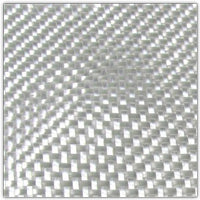
Fiberglass comes in E glass and S glass types. E-glass is more commonly used and is less expensive. S-glass is more expensive, and has been altered chemically to make it stronger than E-glass.
Fiberglass is typically white, but is available in other colors, is relatively lightweight and strong, easy to work with, and can handle tension (pulling), compression (pushing), and cyclical loads well.
Fiberglass comes in various weights as woven cloth and woven roving, nonwoven material such as knitted fabrics or unidirectional materials, and CSM (chopped strand mat).
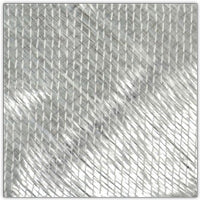
With the exception of CSM, lower weight fiberglass materials turn completely transparent when wet out with epoxy, polyester, or vinyl ester resin; CSM turns transparent only when wet out with polyester or vinyl ester resins, which contain a solvent (styrene) that breaks down the mat that bonds the fibers in place.
You can still wet out CSM with epoxy resin, but the CSM will stay white, and will not conform to complex contours. Fiberglass is the least expensive of the reinforcement materials.
Carbon Fiber
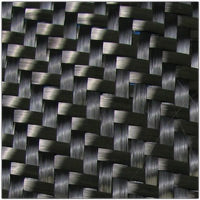
Carbon fiber has the lightest weight and the highest strength and stiffness of all the reinforcement materials, and is best at handling tension (pulling), compression (pushing), and flexural (bending) loads well.
Carbon fiber is either black or dark gray, and retains its original color after wet out, which is why it’s often used for its "wow" in cosmetic applications. Carbon fiber is generally more expensive than fiberglass or aramid.
Kevlar (Aramid)
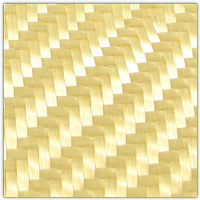
Aramid fibers lack good compressive strength, but provide high tensile strength for their weight, and have excellent abrasion resistance and impact resistance.
Aramid is not easy to work with—it’s hard to cut, and it frays easily. The cost is in the range between fiberglass and carbon fiber.
Here are the relative properties for fiberglass, carbon fiber, and aramid (Kevlar).
| Properties | Fiberglass | Carbon Fiber | Kevlar |
|---|---|---|---|
| Tensile Strength | Fair | Excellent | Good |
| Compressive Strength | Good | Excellent | Poor |
| Abrasion Resistance | Fair | Fair | Excellent |
| Moisture Resistance | Good | Good | Fair |
| Density | Poor | Excellent | Excellent |
| Sanding Ability | Excellent | Excellent | Poor |
Fabric Weight
All reinforcement materials come in different weights, such as 1.5 ounces, 4 ounces, 6 ounces, 12 ounces and more.
As an example to help you understand how weight is a consideration when choosing fiberglass, if you wanted a natural or bright finish on a small wooden boat, you need to use 4 oz. fiberglass cloth because it turns completely transparent when wet out. Heavier fiberglass cloth may not be as transparent. If your goal is better abrasion resistance, you need to use a heavier 10 to 12-oz. fiberglass cloth for your layup.
When buying reinforcement materials, it’s important to note the following:
- Woven and nonwoven material is specified in ounces per square yard (oz/yd2)
- CSM is specified in ounces per square foot (oz/ft2)
Generally, the heavier the reinforcement material, the stronger the composite will be.
When considering reinforcement materials, understand that the outermost plies (layers) in a laminate need to be the strongest because that’s where the loads are the greatest, and the innermost plies can be less expensive materials to provide bulk because they are not under as much stress.
Comments
0 comments
Please sign in to leave a comment.