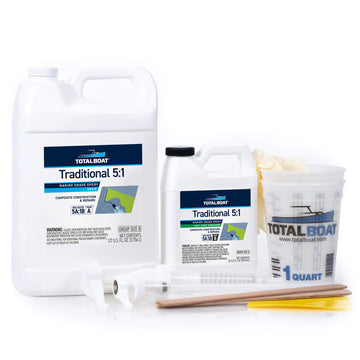







Proper bonding is the key to a strong laminate, and different resins form different types of bonds. The resin you choose depends on what type of bond you’re trying to achieve.
The type of bond you need depends on what you’re doing. Are you building or repairing? If you’re building, are you finishing with gelcoat, or with primer and paint? If you’re doing a repair, how large is the repair area, and what are you finishing with?
For a successful layup, it’s important to understand a little about primary and secondary bonds because they will dictate the resin you choose.
What are Primary and Secondary Bonds?
A primary bond is a chemical bond that occurs between chemically compatible resins during the initial curing stage. A primary bond, such as in a newly molded boat hull is much stronger than a secondary bond, such as a repair.
A secondary bond is a mechanical bond that forms between a newly applied resin and a properly prepared surface that has already cured. Epoxy resin forms stronger mechanical bonds than polyester/vinyl ester resins.
Polyester/vinyl ester resins are chemically compatible with each other, but are not completely chemically compatible with epoxy resins.
For this reason, epoxy resins can be applied over polyester/vinyl ester resins to achieve a chemical bond, but polyester/vinyl ester resins can not be applied over epoxy resin.
For primary bonds, the "wet-on-wet" bonding is strongest between chemically compatible resins, so if you’re finishing with gelcoat, you have to use polyester resin or vinyl ester resin in the layup.
For secondary bonds, epoxy resin is recommended because of its superior strength. It’s typically used to repair fiberglass that’s finished with epoxy primer and paint, or to attach structural parts to a previously cured surface. It’s also used in structural layups where the hull will be finished with primer and paint, not gelcoat.
The common wisdom is that gelcoat is not recommended over epoxy because they’re chemically incompatible and it’s not possible to achieve a primary bond.
However, for relatively small cosmetic repairs, epoxy resin can be used in the repair layup as long as you do the following:
- Measure the epoxy and hardener accurately, mix properly, and apply as directed
- Allow to cure completely
- Use a Scotch-Brite pad and water (not solvent!) to remove amine blush properly and completely, and dry completely
- Prepare the surface properly, according to the gelcoat manufacturer’s directions
- Apply the gelcoat finish beyond the edges of the repair area
Comments
0 comments
Please sign in to leave a comment.