










Exposure to the toxic resins, corrosive hardeners and catalysts, and fibrous reinforcement materials used in the wet layup process can be hazardous to your health. Personal safety and the use of proper personal protective gear should always be your first priority.
Other considerations for wet layup include the layup method, resin type, fiber reinforcement material, fiber orientation, resin/fiber ratio, and curing.
Layup Methods
The most common ways to saturate reinforcement fabric with resin include wet or prepreg hand layup, and resin infusion.
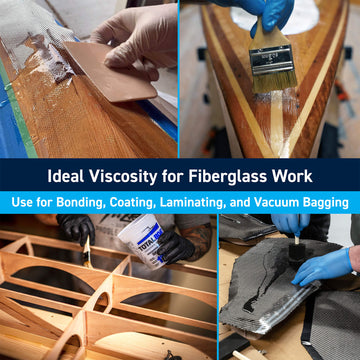
Wet Layup involves wetting out the reinforcement material and laying it onto a prepared surface by hand. We’ll cover this method in detail on this How To page.
Prepreg Layup Prepreg (pronounced pree’ preg) is reinforcement material that’s been pre-impregnated with resin and stored at very cold temperatures until ready to be applied by hand to a prepared surface.
Resin Infusion involves placing reinforcement material on a prepared mold inside a plastic bag, sealing the bag, injecting resin, and applying vacuum pressure to distribute the resin evenly to saturate the reinforcement material.
Resin types
Resins used in wet layup can be epoxy, polyester, or vinyl ester. They look similar but are very different in terms of their curing mechanisms, primary and secondary bonding strengths, and chemical compatibility.
Choose a resin system that creates the strongest bond between the reinforcement materials and the substrate, and between the top reinforcement layer and the finishing material.
Fiber types
There are many types of reinforcement materials including fiberglass (cloth, woven roving, unidirectional, multidirectional), carbon fiber (graphite), Kevlar (aramid), hybrids, CSM (fiberglass chopped strand mat), and many others.
The reinforcement material needed depends on where, why, and how you’re applying it, the type of resin you’re using, and how much you want to spend.
Fiber orientation
It’s important to position the direction of the fibers in the layer(s) of reinforcement material according to the direction of the loads placed on the area being laminated.
Because laminates are built from plies (layers), the fibers in the plies need to be placed so that loads are distributed evenly and shared among the plies. Fiber orientation has a direct effect on strength, stiffness, and dimensional stability.
Fiber to resin ratio
In a layup, this is the percentage of reinforcement fabric to the percentage of resin needed for wet out and to achieve the desired properties.
Typically, the heavier the reinforcement material, the greater the amount of resin needed to saturate the material. It’s most important to know that to achieve greater strength, the laminate needs to include more fiber content than resin.
An optimal fiber to resin ratio is typically 60 percent fiber to 40 percent resin.
Curing methods
Resin can cure either in the open air or in the presence of applied vacuum pressure through a process called vacuum bagging. This Wet Layup page focuses on the air-curing method.
The vacuum bagging process involves placing the layed up piece inside a plastic bag, applying layers of release and breather fabric atop the resin-saturated laminate layer(s), sealing the bag, and applying vacuum pressure until completely cured.
The benefit of vacuum bagging is that it removes all excess resin and trapped air, resulting in a laminate that is lighter and void-free giving it better strength.
Comments
0 comments
Please sign in to leave a comment.