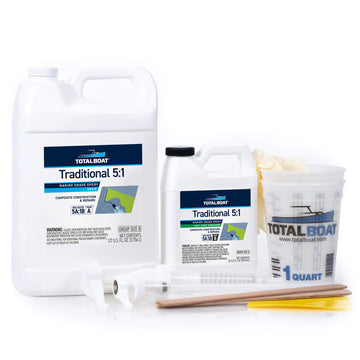












Fairing putties either come "premixed" with the resin and thickener already mixed and you just mix in the hardener or catalyst when you get ready to use the compound. Or you can use the "recipe method" to mix your own fairing compound using separate resin, hardener/catalyst, filler, and additive. Always follow the manufacturer’s safety instructions and wear appropriate personal protection when working with all resins, fillers, and additives.
Epoxy Fairing Compounds
The Recipe Method: With this method, you take separate ingredients and mix them together to the desired consistency (think peanut butter). Ingredients include epoxy resin, hardener, a thickener (colloidal silica) to thicken and prevent sagging, and microballoons to make the putty easier to sand after curing, which might take a day or more. It’s very important to always mix the epoxy resin and the hardener first before mixing in additives. Also, you want to work quickly as the curing reaction, and, therefore, the working time, starts once the resin and hardener are mixed.
Epoxy resin hardeners come in various types. A fast hardener is typically used in cold weather to expedite the curing process. A slow hardener is ideal for extending the working time of epoxy resin in warmer temperatures. This extra working time is especially helpful if it’s your first time using an epoxy resin system, or if you have a particularly complex project. The fast and slow hardeners cure to a light amber color. If you’re doing a clear or bright finish, use a clear hardener. Clear hardeners have a colorless cure, and are typically slow curing, though there are fast curing types.
The Pre-Mixed Method: TotalBoat TotalFair is a ready-to-mix kit that simplifies the fairing process. This formula has a yellow resin paste (part A) that already has the fillers blended in, and a blue hardener paste (part B). Mix them 1 part resin to 1 part hardener by volume until the putty turns a solid green with no swirls, and apply. Its simple 1:1 mix ratio and obvious color change make it much easier to use than other pre-mixed epoxy fairing putties.
With epoxy fairing compounds, the recipe method is good if you’re already using a liquid epoxy resin system for other projects. It’s also good if you’re finishing wood bright and don’t want the fairing putty to show. If this is the case, you would use your liquid epoxy resin, a clear hardener, and a filler that matches the wood to thicken the mixed epoxy. An example of a filler would be to use the dust from the particular wood being used, such as mahogany. Wood flour is a thickening agent, but the color of it does not match all woods, and it is typically used for fillets.
Otherwise, the pre-mixed method has the following advantages over the recipe method:
- Fillers are pre-mixed in the resin, saving you time and guesswork.
- A simple mix ratio makes it easier to get the perfect consistency every time.
- It cures much faster and is ready to sand in a couple of hours.
- The cured color stands out on the surface, making it easy to sand.
Polyester and Vinyl Ester Fairing Compounds
The Recipe Method: This method involves mixing together separate polyester resin containing wax and catalyst (MEKP or methyl ethyl ketone peroxide), a thickener such as (colloidal silica) to thicken and prevent sagging, and microballoons to make the putty easier to sand after curing. The resin and catalyst are mixed thoroughly first, then the filler and microballoons are added and mixed to the desired consistency (think peanut butter).
If you want to use a liquid polyester resin system you already have at hand, check to see whether it contains wax. Polyester resins are either "laminating" or "finishing" resins. The difference is that the polyester laminating resin does not contain wax, so it doesn’t cure fully while exposed to air. Polyester finishing resin contains wax. Finishing resin is the final coat in a polyester wet layup application, and needs to cure properly. The wax is what allows this curing to occur. If you want to use a liquid polyester laminating resin, you must add wax to the polyester laminating resin first, before adding the MEKP catalyst.
The Pre-Mixed Method: The faster, easier, cheaper way to fill dents and small gouges is to use a pre-packaged filling/fairing compound. These products typically contain a thickened polyester or vinyl ester resin compound and separate hardener. They provide easy instructions for mixing resin and hardener in precise amounts.
Comments
0 comments
Please sign in to leave a comment.